
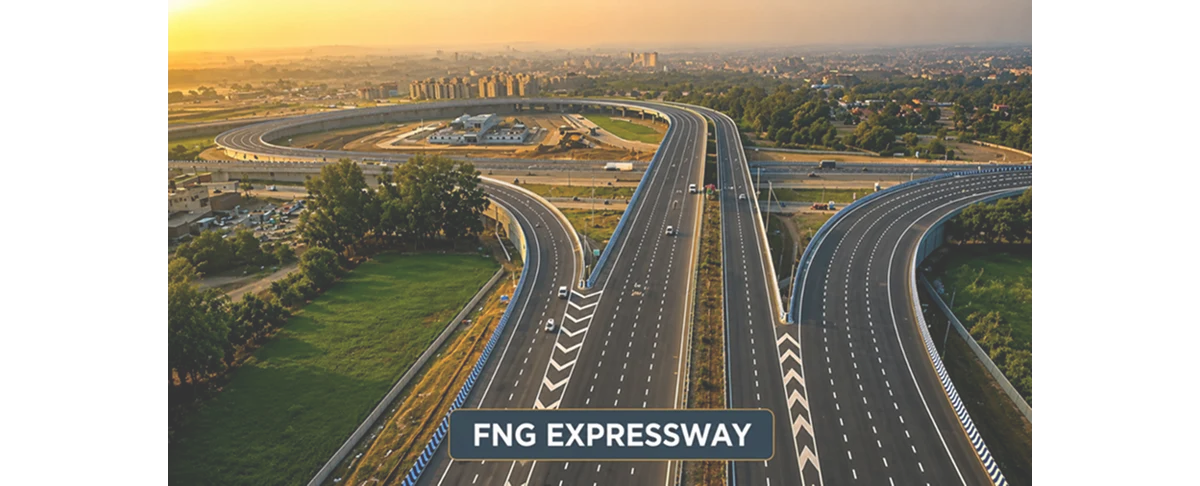

FNG Expressway & UER 2: The 2026 Noida Connectivity Update
For years, conversations about NCR’s growth have centred on destinations where the new business districts are emerging, which residential corridors are attracting families, where the next wave of infrastructure investment is headed.
In 2026, the more interesting question is different. How quickly and comfortably can people actually move between all of it?
That shift in focus matters. The difference between a forty minute commute and a seventy minute one isn’t just a transportation statistic. It shapes family routines, determines how much time people have for themselves after work and influences whether a home feels well placed or perpetually inconvenient. Two infrastructure projects the FNG Expressway and Urban Extension Road-II (UER 2) are changing that equation for a significant portion of NCR residents and their impact on residential choices is already visible.
What FNG and UER 2 Actually Do
The Faridabad-Noida-Ghaziabad Expressway has long been envisioned as a critical regional connector. Once fully integrated into the broader network, it strengthens movement between three major urban centres while reducing dependency on existing routes that have struggled to keep pace with the corridor’s growth. For Noida residents specifically, the improved reach toward Faridabad and neighbouring districts opens up a wider network of employment hubs, educational institutions and healthcare facilities that previously required navigating congested alternatives.
UER 2 addresses a different but equally practical problem. The corridor is expected to provide faster access to Dwarka, IGI Airport and major transit links across western Delhi destinations that many NCR professionals and families reach regularly. Airport connectivity in particular is one of those quality of life measures that sounds mundane until you’ve spent an unpredictable ninety minutes getting there. Similarly, easier movement toward Gurugram’s commercial districts has real consequences for professionals whose work takes them across the region multiple times a week.
Together, these two projects don’t just add roads. They change the mental map of what feels accessible from where you live.
How Buyer Priorities Are Shifting
Residential decisions in NCR used to be simpler. Proximity to one workplace was often the dominant criterion and everything else followed from that.
Today’s reality is more distributed. Many professionals work across multiple locations or from home part of the week. Families travel regularly between different parts of NCR for schools, healthcare and family commitments. Hybrid work has changed not just where people work but how they think about commuting-the occasional long journey matters more when it can’t be predicted or absorbed into a daily pattern.
As a result, buyers are now asking questions that reflect a broader sense of geography. How easily can I reach the airport? What does movement toward Gurugram look like? How will connectivity here change over the next five years? These questions are shaping residential preferences in ways that extend well beyond traditional location logic.
Infrastructure projects like FNG and UER 2 strengthen the appeal of locations that already offer quality living environments because they remove the one practical concern that might otherwise give buyers pause.
Why Sector 150 Benefits Specifically
Among the sectors that stand to gain from these connectivity improvements, Sector 150 sits in a particularly strong position.
The sector has built a clear identity around lifestyle quality. Extensive green spaces, wide internal roads, jogging and cycling infrastructure, sports facilities and a planned environment that supports active daily routines. It carries Noida’s Sports City designation and that reflects genuine intent in the planning rather than a marketing label. Residents here already speak about the ordinary texture of life in terms that are relatively rare in dense urban settings: morning walks that are genuinely pleasant, children who gravitate outdoors naturally, evenings that allow actual recovery rather than extension of the working day.
What the FNG and UER 2 connections add to this picture is range. Residents gain easier access to Delhi, Gurugram, Dwarka and IGI Airport without giving up the environment they chose. That combination of a well-planned, green living environment and strengthening regional connectivity reflects exactly what a growing segment of NCR buyers is looking for.
What Prateek Group Has Understood About Connectivity
For Prateek Group, connectivity has never been viewed purely as a location advantage to be cited in a sales conversation. Over more than two decades of building communities across NCR and across more than 20 million square feet of delivered development one observation has remained consistent. Better connectivity improves the texture of everyday life in ways that residents feel long after they’ve stopped thinking about their commute.
It means a parent gets home in time for dinner rather than missing it. It means a routine hospital visit doesn’t consume an entire morning. It means the friction that accumulates across hundreds of small journeys each year is reduced and that time is returned to the people who would otherwise spend it in traffic.
This understanding shapes how Prateek approaches community planning. The focus has never been limited to what happens within the boundary of a project. It extends to how residents experience the city around them and how thoughtful location decisions made years before a project is delivered continue to benefit families across different stages of life.
That is what “Creating Landmarks, Setting Benchmarks” has always meant in practice. Not impressive architecture for its own sake but planning decisions that hold up over time. More than 50,000 families now live in Prateek communities across NCR and with over 10 million square feet currently under development the same principles guide every project in the pipeline.
“Trust. We Know What It Means” points to something that takes years to build and is difficult to manufacture. It comes from consistency from delivering what was promised, maintaining what was built and continuing to invest in communities long after possession.
Life at Prateek
One dimension of residential life that rarely features in infrastructure discussions but consistently shapes how satisfied residents actually are, is what happens within the community itself, the daily and seasonal rhythms that turn a well located building into a place people genuinely want to be.
Prateek Group has invested in this through its ongoing Life at Prateek initiative. Across its communities, festive celebrations bring neighbours together throughout the year in ways that go beyond casual corridor acknowledgements. Wellness sessions and sports activities make health a shared habit rather than a solitary discipline. Cultural programmes, family events and hobby groups give residents regular reasons to connect and those connections, repeated across months and years, build something that matters: familiarity with the people around you, comfort in your surroundings and the kind of belonging that makes a neighbourhood feel like more than a collection of flats.
Children develop friendships within the community that carry through school years. Families build traditions around annual events they look forward to returning to. Residents who moved in as strangers find themselves with neighbours who know their names and their routines. The daily conveniences built into Prateek communities accessible green areas, well maintained shared spaces, facilities that serve real needs rather than just appearing on a feature list support this in practical ways, making it easier for residents to spend time together rather than simply near each other.
Communities of this kind don’t form quickly. They build gradually through shared experience and repeated interaction, until the social fabric of the neighbourhood becomes as much a part of life as the flat itself.
Looking Ahead
The significance of FNG and UER 2 extends beyond traffic counts and travel time projections. They represent a meaningful step toward a more integrated NCR, one where the distance between Noida, Delhi, Gurugram, Dwarka, and the emerging Jewar corridor feels progressively more manageable.
For residents already living in well-planned communities along this corridor that integration adds practical value to decisions already made. For buyers still evaluating their options, it changes the calculus on locations that combine connectivity with genuine quality of life.
For Prateek Group, it reinforces a belief that has guided two decades of development across the region: that the best residential communities are those planned not just for where NCR is today but for where it is heading and for the people who will build their lives there along the way.
For more details visit Prateek Group Official Website
Connect with Prateek Group
Instagram: Prateek Group Instagram
LinkedIn: Prateek Group LinkedIn
YouTube: Prateek Group YouTube Channel
Facebook: Prateek Group Facebook Page
Corporate Office:
A-42, Sector-67, Noida, Uttar Pradesh, India
Email: info@prateekgroup.com