


What to Teach, What to Leave
Rethinking the boundary between design education and industry training
By Nirali Parekh Soni | Educator, Author, Artist & Interior Designer
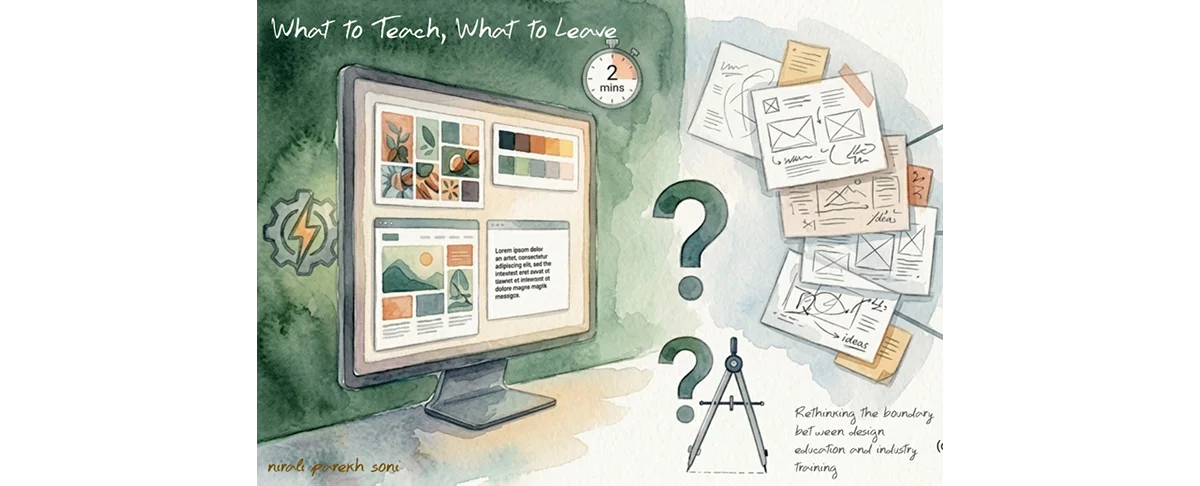
It’s crit day. A second-year student opens their laptop, and in under two minutes an AI tool has produced a full mood board, a colour palette, three layout options and a paragraph of on-brand copy – technically accomplished, current, ready to post.
The tutor asks one question: “Why this direction, and not one of the other two?”
The student doesn’t have an answer. Not because they’re lazy or unprepared. Because nothing in the two minutes it took to produce the work asked them to decide anything. The tool decided. The student approved.
This scene is no longer rare. It’s becoming normal. And it forces a messy, honest question: when a tool can produce the output, what exactly is a design education still choosing to teach?
The software always wins the race we set it
This isn’t the first time a tool has threatened to outpace the classroom. The T-square gave way to CAD, CAD to Photoshop, Photoshop to Figma. Each generation collapsed the gap between a novice’s output and an expert’s – and each time, design education adjusted, shifting its attention toward whatever the tool still couldn’t do.
What’s different now is the shape of the thing the tool has taken over. Earlier tools sped up execution – the hand that draws faster, the layers that update instantly. Generative AI does something else: it performs ideation itself. It generates the options, not just the artwork. And ideation, the act of generating and weighing options, is precisely the muscle of design curriculum that were built to train.
What design schools always assumed they were teaching
Traditional design education taught technique and judgement together, often without separating them, because the technique was slow enough to force judgement to happen in the open. Sketching by hand made you choose – which line, which direction, which idea to keep and which to abandon – because you could only draw one thing at a time. The slowness wasn’t a limitation the curriculum tolerated. It was, quietly, the curriculum.
“The slowness used to be the pedagogy. Now the slowness is optional.”
Remove the slowness, and the question a school has always answered by default – technique and judgement will simply be learned together, because there’s no other way to produce the work – stops answering itself. Something has to answer it on purpose now.
Two students, one output
Picture two students given the same brief and the same AI tool. The first generates ten options, picks the one that looks strongest, and submits it. The second generates the same ten options, discards seven for reasons they can articulate, tests the remaining three against the brief, and defends the one they keep.
On the wall, in the crit, their work can look identical. A tutor scanning the room might not be able to tell the difference by looking. The only way to know which student practised judgement and which one didn’t is to ask – the same question the tutor asked in the opening scene. Which raises an uncomfortable possibility: a classroom that evaluates only the output, not the reasoning behind it, may no longer be able to tell whether it’s teaching design or simply grading someone else’s software.
What’s actually left to teach, if the tool can produce the output?
If the tool can generate options and even execute them, what’s left is narrower but harder:
- Framing a sharper brief than the one you were given.
- Building a point of view you can defend under pressure.
- Rejecting the option that looks right but isn’t.
- Understanding cultural, ethical and human context that a tool can’t see.
- Being okay with being questioned in a room, in real time, and having an answer that isn’t “the software suggested it.”
None of this shows up automatically in a pretty layout. All of it shows up the moment someone asks “why?”
Is this an old panic in new clothes?
Every generation of tools has provoked some version of this anxiety. The calculator was going to end arithmetic. The camera was going to end painting. The word processor was going to end writing.
Each time, the skill didn’t disappear. It relocated.
But generative AI raises a slightly different possibility.
A calculator still required you to know which numbers to enter. A generative tool can supply the options, the operation and a plausible-looking answer sometimes before a student has had reason to ask what the question even was.
That may turn out to be a difference of degree.
It may turn out to be a difference of kind.
Design education doesn’t yet have a settled answer. Pretending otherwise in either direction would be premature.
What belongs in the classroom and what doesn’t?
There is another distinction worth making: design education is not industry training.
A design school cannot teach every software update, AI platform or production workflow the industry will use next year. Nor should it try to.
Industry can teach speed, deadlines, clients, budgets, negotiations and real-world constraints.
The classroom has a different opportunity.
It can give students the time to question, experiment, fail, defend an idea, change their mind and understand why they changed it.
If industry teaches students how to work faster, education must help them understand what is worth doing faster.
This also changes how we think about assessment.
Perhaps the final image, model or presentation should no longer carry the entire weight of evaluation. The thinking behind it becomes evidence: What did the student consider? What did they reject? What changed after critique? Where did AI assist and where did the student disagree with it?
The question is no longer how much of the work was made by the student’s hand.
It is how much of the thinking belongs to the student.
The real question isn’t about the tool
It’s tempting to frame this as a policy decision to allow the tool in the classroom, or don’t.
But the deeper question is what we choose to teach directly, and what we assume students will learn elsewhere: from industry, from mentors, from experience, or now, from technology.
Every time a brief introduces generative AI without asking what capacity it might quietly replace, a choice has already been made about what the classroom is for.
Perhaps that choice needs to become conscious.
An open question, left open
Maybe the more useful question for a design classroom isn’t whether to allow the tool.
It is:
What should students experience before the tool gives them an answer?
Should they observe before generating?
Question before selecting?
Develop a point of view before asking a machine to provide one?
AI can produce options. It can accelerate execution. It can participate in ideation.
But education must continue to teach students how to question, select, interpret, reject and defend.
Because when a tool can produce ten answers in seconds, the valuable designer may not be the person who produces the eleventh.
It may be the person who knows which question was worth asking in the first place.
And perhaps that is what design education needs to protect not the act of making everything by hand, but the act of thinking before accepting what has been made.
Sources
Schön, D. A. (1987). Educating the reflective practitioner. Jossey-Bass.
Risko, E. F., & Gilbert, S. J. (2016). Cognitive offloading. Trends in Cognitive Sciences, 20(9), 676–688.
Tellez, M. (2026). Cognitive offloading, critical pedagogy, and generative AI in higher education. Higher Education Research & Development.
https://www.tandfonline.com/doi/full/10.1080/07294360.2026.2700227
Kim, Y., et al. (2025). Generative AI in studio-based design education: Human–AI collaboration, critique, and assessment. Proceedings of the IASDR 2025.
https://dl.designresearchsociety.org/iasdr/iasdr2025/fullpapers/252/
Mohsen, J. (2026, May 14). Beyond bans: AI-resilient and creative HE assessment design. Times Higher Education Campus.
https://www.timeshighereducation.com/campus/beyond-bans-airesilient-and-creative-he-assessment-design
ABOUT THE AUTHOR

Nirali Parekh Soni is an educator, author, artist and interior designer whose work explores the relationship between people, perception and designed environments. Her interests move across visual narrative, spatial storytelling, design education, art, materiality and the psychology of seeing – and how people read visual clues, build associations, and turn information into meaning.
As an educator she works at the intersection of design thinking and visual communication, and is particularly interested in what a design classroom chooses to protect as the tools around it keep changing.
As an artist she investigates perception through colour, line and visual expression; as an interior designer she studies how material, light, scale and spatial sequence shape experience; and as an author she writes about design not only as something we create, but as something that shapes the way we see, learn and think.