


FLUX-FREE CONTINUOUS ROTARY-KILN SYNTHESIS OF CRISTOBALITE-RICH SILICA FROM NATURAL QUARTZ
AN INTEGRATED MINERALOGICAL, THERMAL, KINETIC AND PROCESS-ENGINEERING STUDY
NATURAL QUARTZ FEEDSTOCK: THE STARTING SILICA-RICH MINERAL RESOURCE FOR THERMAL CONVERSION.
INNOVATION & TECHNOLOGY :- SYNTHETIC CRISTOBALITE — CRISTASIL
CORE PRODUCT :- ADVANCED CRYSTALLINE SILICA TECHNOLOGY (ACST)
TECHNICAL TITLE:- FLUX-FREE SINTERED SYNTHETIC CRISTOBALITE TECHNOLOGY
FOR ADVANCED APPLICATIONS
ABSTRACT
Cristobalite is a crystalline polymorph of silica (SiO₂) used in selected refractory, ceramic, foundry, glass, coating and specialty-material applications. Producing it from natural quartz in a continuous industrial unit is challenging because phase development depends on temperature, heat-transfer uniformity, particle size and residence time. This article describes a flux-free rotary-kiln route developed by Raghuvamsi Technologies, India, to convert silica-rich quartz without alkali fluxes or external mineralizers. The process combines feed preparation, staged heating, high-temperature treatment and X-ray diffraction (XRD)-based phase assessment. The reported sample contains approximately 90% α-cristobalite and 10% residual low quartz, indicating substantial conversion while identifying scope for further optimization. These are process-development findings; scale-up and end-use qualification require reproducible data and application-specific testing.
RAW MATERIAL AND MINERALOGICAL BASIS
LABORATORY/PROCESS-DEVELOPMENT STAGE SUPPORTING CONTROLLED PREPARATION AND CHARACTERIZATION OF THE QUARTZ-DERIVED MATERIAL.
The starting material is natural quartz or silica-rich feed, prepared to a nominal particle-size range of approximately 3–30 mm for rotary-kiln processing. Feed consistency matters: oversized particles may develop surface-to-core temperature gradients, while excessive fines can affect bed permeability, dust loading and heat transfer. Where necessary, beneficiation and washing can reduce impurity-bearing minerals. Iron-, titanium- and aluminium-bearing components should be monitored because they can influence colour, high-temperature behaviour and product chemistry. Representative sampling and chemical analysis establish the feed baseline. The main transformation is structural: the silica framework reorganizes at high temperature, and conversion depends on the thermal history experienced by each particle.
CONTINUOUS ROTARY-KILN TRANSFORMATION
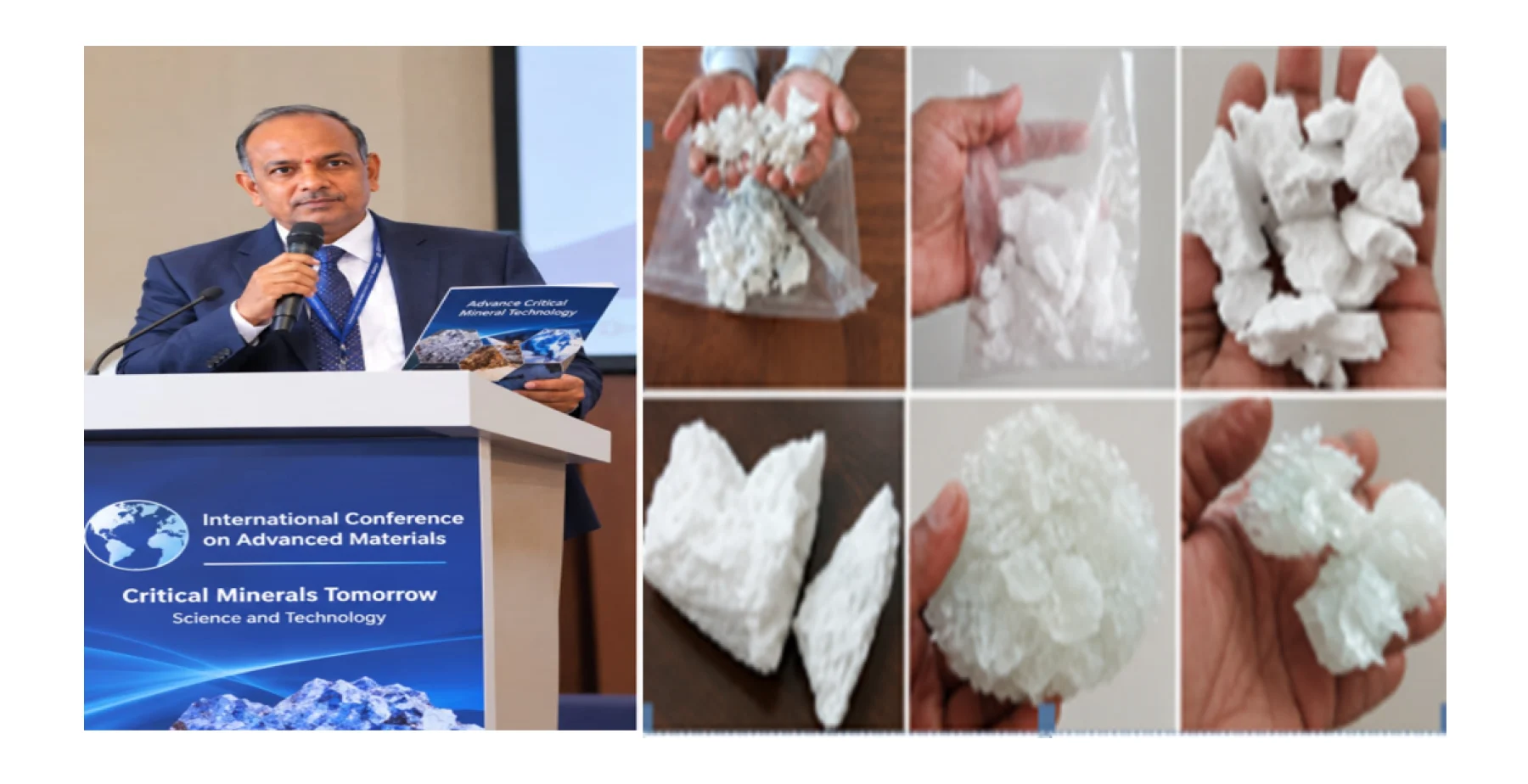
WHITE SINTERED CRISTOBALITE PRODUCT OBTAINED AFTER HIGH-TEMPERATURE TREATMENT.
The rotary kiln uses coordinated preheating, reaction and high-temperature sintering zones, with reported treatment at approximately 1700–1750 °C. Kiln rotation advances feed through the heated zones, while gas–solid heat transfer and residence time determine thermal exposure. The process is designed to operate without alkali fluxes, chemical catalysts or external mineralizers, avoiding intentional introduction of these additives. This alone does not prove lower environmental impact or guarantee product purity; energy, emissions and chemical data are needed. Temperature, feed rate, kiln speed and discharge consistency are key operating variables. Industrial performance should be assessed from steady-state records and samples collected at multiple time intervals, rather than a single sample.
PHASE AND STRUCTURAL CHARACTERIZATION
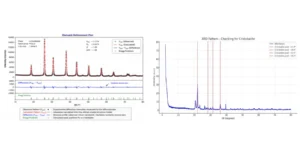
XRD/RIETVELD-TYPE PHASE ANALYSIS USED TO VERIFY CRISTOBALITE FORMATION AND RESIDUAL QUARTZ.
REPORTED PHASE-COMPOSITION DISTRIBUTION FOR THE INVESTIGATED CRISTOBALITE SAMPLE.
XRD is the principal method reported for identifying product phases. The supplied interpretation indicates approximately 90% α-cristobalite and 10% residual low quartz; no significant tridymite or amorphous/glassy phase was reported as detectable. These values describe the investigated sample, not a guaranteed production specification. Quantitative phase fractions depend on data quality, the refinement model, included phases and treatment of background and preferred orientation. If Rietveld refinement is used, the report should identify reference patterns, refinement procedure, fit indicators and uncertainty where available. Residual quartz indicates that conversion is substantial but incomplete, warranting further study of particle size, residence time and particle-core temperature. A phase not detected in a pattern may still be present below the method’s detection capability.
MICROSTRUCTURE, PRODUCT QUALITY AND APPLICATIONS

The product is described as white and crystalline, with a consolidated, fine-grained appearance. Whiteness is useful for selection but cannot replace quantitative quality control. Product release should combine representative sampling with XRD and, as appropriate, XRF or another validated chemical method, particle-size distribution, bulk density, loss on ignition and application-specific thermal tests. Scanning electron microscopy (SEM) can help assess grain development and heterogeneity; energy-dispersive X-ray spectroscopy (EDS) provides local elemental information but does not replace bulk analysis. Potential applications include refractories, advanced ceramics, foundry and investment casting, paints and coatings, thermal insulation, specialty glass and selected electronic or composite systems. Suitability depends on phase composition, impurities, particle size, thermal expansion and end-use requirements. Cristobalite undergoes a temperature-dependent structural transition, so thermal cycling and dimensional stability must be considered in design and safety assessment.
CONCLUSION :-
The process demonstrates a promising continuous route for converting natural quartz into cristobalite-rich silica without intentionally added fluxes or mineralizers. Its value lies in integrating feed preparation, rotary-kiln thermal zoning and phase verification. The reported XRD result—approximately 90% α-cristobalite with residual quartz—supports substantial transformation but shows that further optimization is needed before complete conversion or a tightly controlled commercial specification can be claimed. Next steps include repeat runs under documented steady-state conditions, recording particle residence-time distribution and temperature profiles, and sampling across production intervals. Quantitative phase analysis should report its method and uncertainty; chemistry, particle size and thermal properties should be measured using documented procedures. A validated mass and energy balance would strengthen the scale-up case.
PROCESS INNOVATION AND INDUSTRIAL RELEVANCE
The innovation is a continuous rotary-kiln configuration for flux-free quartz-to-cristobalite conversion. Potential benefits include throughput, operational continuity and consistency compared with prolonged static treatment, but these should be quantified against a defined reference process. Critical control points include feed chemistry and sizing, kiln-zone temperature, rotation and feed rate, residence time, cooling and final phase composition. Acceptance limits should be set only after repeatability and customer requirements are established. Further work should correlate process parameters with residual quartz, cristobalite fraction, microstructure and thermal properties. Energy use, emissions, refractory wear, yield and product variability should also be reported to assess sustainability. With process controls and application-specific qualification, the technology may add value to natural silica resources and supply engineered cristobalite-rich material to selected specialty markets.
I.V. SUBBA RAO
Email: ivsrao2003@yahoo.co.in
raatechs12@yahoo.co.in, raatech12@rediffmail.com
Mob:- 7569160194.