


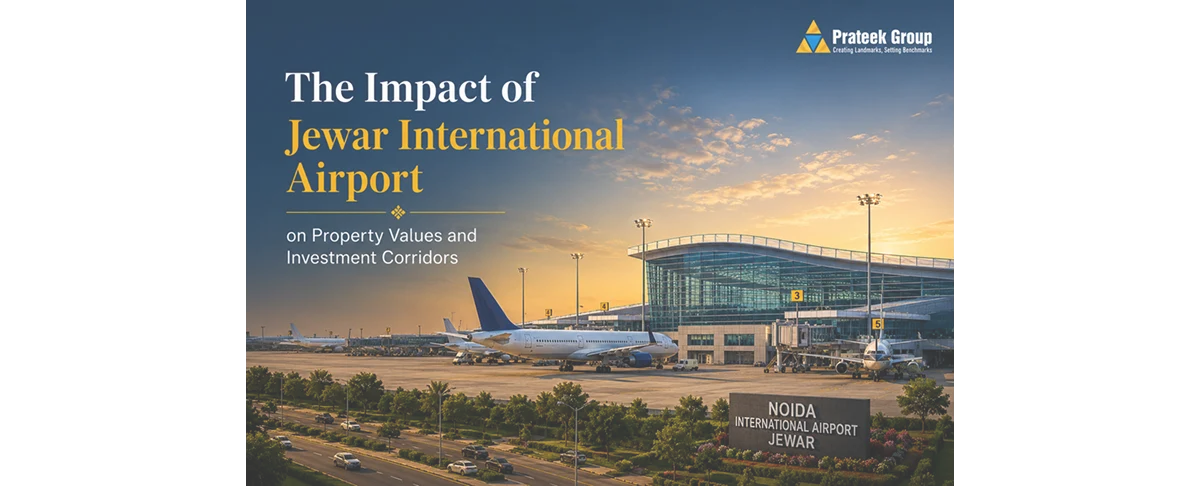

The Impact of Jewar International Airport on Property Values and Investment Corridors
On 28 March 2026, Prime Minister Narendra Modi inaugurated Phase 1 of Noida International Airport at Jewar. Commercial flight operations have now commenced, beginning IndiGo’s inaugural service connecting Jewar to Lucknow, with onward routes to Bengaluru, Hyderabad, Jammu, Amritsar, and Navi Mumbai marking the moment this infrastructure story moved from milestone to daily reality. The effects on how this region thinks about property, connectivity, and daily life are no longer projections. They are observable, starting now.
What Jewar represents is not simply a second airport for the National Capital Region. It is infrastructure that redraws a region’s internal geography, shifting which corridors attract investment, which neighbourhoods gain renewed relevance and which communities find themselves, almost overnight, far better connected than before.
What Has Already Changed
The numbers that have emerged since inauguration tell a clear story. Property values along the Yamuna Expressway corridor have appreciated sharply. Apartment prices in the area have nearly tripled between 2020 and 2025 and plot values in select micro markets have seen up to five times growth over the same period. Experts project a further 20 to 30 percent upside through 2027 as flight operations establish their rhythm.
Greater Noida, which accounted for 19 percent of total NCR residential launches in 2021, had grown its share to 28 percent by 2025, a shift driven significantly by the airport’s approaching reality. Residential launches in the corridor surged from around 4,400 units in 2021 to nearly 14,000 units in 2025, the observable outcome of a region recalibrating around infrastructure that has now arrived and is operational.
Phase 1 of Jewar is designed to handle 12 million passengers annually through a single runway and terminal. The full build out, planned through 2050, is projected to handle up to 70 million passengers across six runways, positioning Jewar as one of Asia’s largest aviation hubs.
The Corridor That Is Now Moving
The investment corridors radiating from Jewar run north through Greater Noida and into the established residential and commercial zones of Noida. The Yamuna Expressway and the Noida-Greater Noida Expressway form the backbone of this web and the infrastructure supporting them is being actively upgraded. The Ghaziabad-Jewar Regional Rapid Transit System corridor is back on track as a semi high speed rail link connecting Ghaziabad with Greater Noida and the airport, substantially reducing travel time across east NCR.
Sectors considered edge locations even three years ago are now being reassessed with fresh eyes. The physical distance between Jewar and Noida’s established residential belt, Siddharth Vihar, Sector 62, the expressway townships is being compressed in travel time terms as road, metro and rail infrastructure catches up. For buyers making decisions today, a well planned home in this corridor is not a speculative bet on a future that may or may not arrive. That future has arrived and flights are now departing from it.
The buyer profile shifting into this corridor reflects that changed reality: the professionally mobile household, the NRI family maintaining a base in NCR, the executive who measures the value of a home partly in hours saved. These buyers have long investment horizons and they are looking with the kind of scrutiny that only comes once the infrastructure question has been answered definitively.
The Quality Question: A Working Airport Raises the Standard
When an airport moves from planning to operation, the buyer conversation in surrounding corridors changes. Proximity to infrastructure that is hypothetical is one thing. Proximity to an airport actually handling passengers where the road to the terminal is a real daily journey, not a rendering in a sales presentation is materially different.
Those buyers are not evaluating proximity alone. They are evaluating the quality of daily life whether a development can genuinely sustain its green spaces, its community infrastructure, its maintenance culture, its social fabric. For buyers who travel frequently and may be away for weeks at a stretch, there is a specific dimension that matters: the confidence that the community they return to is maintained, alive, and functioning well in their absence. That assurance is found in the track record of the developer and the lived experience of residents already there.
Prateek Group: Built for Exactly This Moment
Prateek Group has been building residential communities across NCR for over twenty years. That timeline is not incidental; the Group has watched multiple infrastructure cycles reshape this region and has consistently made planning decisions oriented toward where the city was heading, not simply where it stood at the time.
More than 20 million square feet delivered across NCR. More than 50,000 families now live in Prateek communities. More than 10 million square feet are currently under development. These figures represent the accumulated experience of a developer that has built through changing markets, delivered on commitments and maintained the quality of its communities long after possession, the result of decisions made correctly, repeatedly, over a long period of time.
Prateek Grand City in Siddharth Vihar, a 40 acre integrated township with more than 4,500 families in residence sits in a corridor that Jewar’s now operational status has directly strengthened. Its combination of green infrastructure, wellness integrated planning, and sustained community investment was a deliberate long-term decision, made years before the airport brought wider attention to this part of NCR. It reflects a philosophy that has guided every Prateek Group project: that homes are life decisions, not transactions and that the quality of daily experience matters more than any single line on a floor plan.
“Creating Landmarks, Setting Benchmarks” has guided Prateek Group’s approach for two decades. In the context of a corridor whose importance has now been confirmed by one of the country’s most significant infrastructure projects now carrying its first passengers, that principle finds its most relevant stage yet.
Life at Prateek: Where the Investment Becomes a Home
The real measure of any residential development is not what it promises at launch. It is what daily life feels like inside it a year after possession, five years on, a decade on where claims about premium living are either validated or quietly set aside.
Life at Prateek is Prateek Group’s sustained commitment to passing that test. It exists because the Group understands that handing over a home begins a relationship, not a conclusion. In communities like Prateek Grand City, that relationship has had years to deepen into something residents describe not as satisfaction but as belonging.
Diwali and Holi celebrations draw residents from across the township together genuinely anticipated annual events that grow larger each year as the community’s social fabric thickens, where children who have grown up on the same open grounds meet neighbours who have become, over years, something closer to extended family. Morning walks through over 150,000 plants that line the township’s landscape see the same faces appear week after week, conversations beginning without introduction much like the fitness sessions, yoga decks, swimming facilities, cultural evenings and senior gatherings that follow their own steady rhythm, sustained by consistent, year on year investment in the infrastructure of community life.
For the professionally mobile household that the now operational Jewar corridor is actively attracting, this matters in a specific way. When work takes a resident to another city for a week, or abroad for a month, a well functioning community is not a background detail; it is why the return home feels like a return, rather than a check-in. The parks are maintained. The shared spaces are active. The neighbours are there. That continuity, quiet, consistent, reliable is what genuinely rooted living feels like and it cannot be installed as an afterthought.
Children who met as neighbours in the township’s open grounds carry those friendships into school and beyond. Families who arrived uncertain about a new address find themselves, years later, unable to imagine living anywhere else. This is the community Prateek Group has built, and continues to build, every year.
The Longer View
Noida International Airport is now open and its first commercial flights are airborne. Its effects on property values, investment corridors and residential demand across NCR are no longer projections; they are observable market reality, unfolding from today. The corridors it has activated through Greater Noida, along the Yamuna Expressway and into the established residential zones of Noida are drawing buyer attention that reflects long term confidence, not short term sentiment.
For developers who have built well, delivered consistently and invested in their communities over the long term, this is not a moment to react to. It is a moment their years of work have quietly prepared them for.
The deepest value this corridor will produce will not be measured in land price per acre. It will be measured in the families who chose to build their lives here, who sent their children to school nearby, who built friendships across tower lobbies and park benches, who found, in a well planned community in a well-connected part of NCR, exactly what they had been looking for. That is the standard against which every project in this corridor will rightly be judged.
Prateek Group has been building trusted communities across NCR for over two decades with 20+ million square feet delivered, 50,000+ families served and more than 10 million square feet currently under development across its residential and township projects.

