Toxic Positivity vs Healthy Optimism
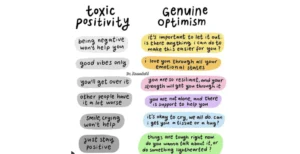
We’ve all seen the posts: “Good vibes only,” “Choose happiness,” or that plastered smile emoji whenever someone mentions a problem. On the surface, positivity sounds great. But there’s a difference between encouraging hope and invalidating real pain.
As a psychologist, I want to help you clearly understand toxic positivity, why it hurts, and how healthy optimism looks and feels in real life.
What is Toxic Positivity?
Toxic positivity is the insistence that people should maintain a cheerful, optimistic mindset no matter how difficult their situation. It implies that negative emotions are wrong, weak, or avoidable — and that the “right” response to suffering is to immediately reframe it into something upbeat.
Common examples:
• Saying “Just be grateful!” to someone grieving a loss.
• Responding to someone’s anxiety with “Stop worrying, think positive!”
• Forcing a smile and pretending everything’s fine while avoiding real conversation.
Toxic positivity isn’t kindness — it’s avoidance dressed up as encouragement. It tells people their sadness is unacceptable and that they must hide or deny their true feelings.
Why Toxic Positivity Develops
There are several roots:
•
Cultural messaging: Social media and self-help mantras often simplify complex pain into catchy slogans.
•
Avoidance of discomfort: People prefer not to sit with others’ strong emotions because it feels uncomfortable or they don’t know how to help.
•
Fear of losing control: Telling someone to “stay positive” is sometimes a way for the speaker to feel like they are fixing the situation.
•
Past trauma: Some individuals were taught early on to suppress negative emotions to keep peace or avoid punishment.
All of these make it tempting to default to positivity as a one-size-fits-all response.
How Toxic Positivity Harms
Although meant to “help,” toxic positivity has real psychological costs:
•
Invalidation of feelings: When a person’s pain is dismissed, they feel unseen and alone. Validating emotions is foundational to healing; removing that validation blocks processing.
•
Shame and self-blame: If someone is told they must be positive, they may feel weak or defective for experiencing sadness or anger.
•
Delayed healing: Emotions need to be acknowledged to be worked through. Avoiding them can lead to chronic stress, anxiety, or depressive symptoms.
•
Weaker relationships: When we deny others’ pain, we shut down opportunities for connection and mutual support.
•
Unrealistic expectations: It sets up the idea that healthy people never struggle, which is false and harmful.
What Healthy Optimism Is — And Isn’t
Healthy optimism means holding a hopeful outlook while honestly acknowledging reality. It’s a balanced stance: you see difficulty, you feel it, and you also believe in the possibility of change or growth.
Key features:
•
Emotional honesty: You allow sadness, anger, fear — then you respond compassionately.
•
Realistic hope: You recognize challenges but maintain confidence in your capacity to cope or find meaning.
•
Problem-focused action: Optimism motivates practical steps rather than magical thinking.
•
Empathy for self and others: You don’t force positivity; you validate feelings and gently encourage agency.
Healthy optimism is not forced cheerfulness. It’s a grounded resilience that accepts pain as part of life while choosing to move forward.
How to Tell the Difference (Practical Signals)
Ask these simple questions when you or someone else responds with positivity:
• Does the response acknowledge the emotion? (“I’m so sorry you’re hurting” vs “At least it’s not that bad.”)
• Does it encourage processing or avoid it? (“Tell me about it” vs “Stay positive!”)
• Is the message empowering or shaming? (“You can take small steps” vs “You should just be grateful.”)
• Is the timing appropriate? (Immediate comfort and validation first; reframing or problem-solving later.)
If the answer leans toward avoidance, it’s likely toxic positivity.
What Healthy Responses Look Like — Scripts That Help
If someone shares pain, try these instead of platitudes:
• “I’m sorry you’re going through this. I’m here with you.”
(Validation)
• “That sounds really hard. What do you need right now?”
(Support + agency)
• “I can’t fully understand, but I want to listen.”
(Empathy)
• “Would you like company or space?”
(Respecting boundaries)
For yourself, try internal scripts:
• “This hurts, and that’s okay.”
• “I can feel upset and also believe things can improve.”
• “Small steps are progress.”
Therapeutic Practices to Move from Toxic Positivity to Healthy Optimism
•
Name the emotion: Labeling (e.g., “I feel scared”) reduces overwhelm and engages the prefrontal cortex for regulation.
•
Practice radical acceptance: Acceptance doesn’t mean liking the situation — it means acknowledging reality to respond wisely.
•
Use cognitive flexibility: Replace all-or-nothing thoughts (“I must be happy”) with balanced ones (“I can experience sadness and still care for myself”).
•
Develop coping plans: Optimism is actionable — small, concrete steps (reach out to a friend, book an appointment, practice a grounding exercise).
•
Self-compassion work: Treat yourself as you would a close friend who’s suffering — with warmth and understanding.
•
Seek therapy when needed: A therapist helps process grief, trauma, or chronic stress and models healthy emotional responses.
When Positivity Is Helpful (and When It Isn’t)
Positivity can be helpful when it:
• Is used
after validation and emotional processing.
• Encourages realistic action.
• Supports resilience without denying pain.
It becomes harmful when used as a quick fix to silence feelings or to avoid difficult conversations.
Final Thoughts — A Gentle Call
Being hopeful is a beautiful human strength. But hope that silences pain is not strength — it’s armor that prevents healing.
If you find yourself defaulting to “just be positive” when someone suffers, pause. Try listening, validating, and offering help before you offer cheer.
To those who are struggling: your feelings are real and important. You don’t have to rush into optimism to be okay. Allow yourself to grieve, to be angry, to be frightened. And when you’re ready, let hope become a companion — patient, honest, and steady.
Healing begins when we stop pretending everything is fine and start being truly present — for ourselves and for each other.
Connect with Dr. Kamakshi
Counselling Psychologist | EFT Trainer | Mental Health Blogger | Anxiety Coach
Founder – Enchanted Self Counselling Services, Kundli, Sonipat, Haryana
📞
Call: +91 9991115590
📸
Instagram: @enchanturself_widdr.kamakshi |
@awakenwith_dr.kamakshi