
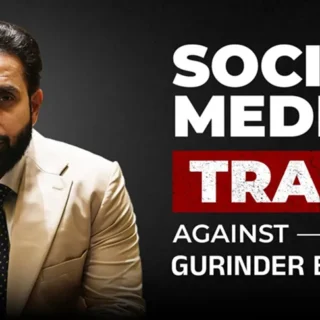



The Social Media Trap: How a Sector-Wide Canadian Controversy Was Turned Against Gurinder Bhatti
CHANDIGARH: Police Complaint over disputed content across YouTube, Instagram and Facebook puts focus on repeated messaging, possible coordinated amplification and the linking of a Canadian student-funding controversy to an Indian real-estate business.
GB Realty has raised concerns over an alleged online campaign targeting the reputation of its Managing Director, Gurinder Bhatti, claiming that a controversy involving student funding and private career colleges in Canada has been used to draw the company and its leadership into a damaging public narrative.
The company approached Punjab Police over 109 disputed social media posts across YouTube, Instagram and Facebook. An FIR was registered against unknown persons, and police approached the platforms regarding the content on the basis of a court order.
The complaint has brought attention to questions extending beyond the content of individual posts: whether similar narratives were repeatedly circulated across platforms, whether account activity indicates coordinated amplification, and how allegations originating in Canada’s education sector became linked to GB Realty’s real-estate operations in Punjab.
From a Canadian controversy to a Punjab real-estate dispute
The original controversy concerns Canada’s Ontario Student Assistance Program (OSAP) and allegations relating to funding at private career colleges. Bhatti’s association with three Academy of Learning campuses brought his name into the debate.
GB Realty maintains that allegations concerning educational institutions and public funding must be assessed through relevant records, regulatory findings and legal proceedings. Reported funding figures and enrolment numbers do not, by themselves, establish individual wrongdoing or prove that a separate real-estate business was involved in any alleged irregularity.
The online discourse extended beyond the original regulatory questions, linking Gurinder Bhatti and GB Realty to the controversy without necessarily establishing a direct connection between the alleged irregularities and the company’s business activities.
Repeated messaging puts digital amplification under scrutiny
The 109 posts identified in the complaint raise questions about how the disputed content originated and spread. A comparison of their wording, publication timelines, shared links and account activity could establish whether the posts represented independent commentary or repeated versions of similar claims circulating across multiple platforms.
The same allegations appearing across different accounts can create an impression of widespread confirmation through repeated exposure, even when the posts trace back to a common source. Establishing whether that occurred in this case would require a systematic review of the content and its distribution.
The authenticity and behaviour of the accounts circulating the disputed content have also come under scrutiny, with repeated narratives across multiple social media platforms raising questions about possible coordinated distribution. The recurring messaging and patterns of publication warrant closer examination to determine whether the content was amplified through inauthentic accounts or automated networks. Establishing the extent of any such activity would require a detailed analysis of the posts, account behaviour and relevant platform records.
Xenophobic framing and anti-immigrant narratives
The use of Canadian influencers to circulate and amplify narratives linking a student-funding controversy to an Indian entrepreneur raises serious concerns about how the issue has been framed and presented to the public. By repeatedly associating allegations involving immigration and international students with an individual’s Indian identity and business interests, such content risks fuelling anti-immigrant sentiment and reinforcing xenophobic stereotypes.
A legitimate debate over public funding must not be turned into a platform for vilifying Indian entrepreneurs or encouraging prejudice based on nationality and immigrant connections. Where influencers reproduce similar claims across platforms without adequate context or independent verification, their reach can give a particular narrative greater visibility and the appearance of broader consensus.
The nature of the content, the messaging used and the manner in which it has been amplified therefore warrant scrutiny to determine whether legitimate public-interest discussion has been overshadowed by prejudicial narratives and reputational targeting.
The timing of the targeted campaign and the Salman Khan project launch
The disputed online content surfaced just one day before GB Realty’s scheduled press conference to launch its new project featuring Salman Khan. The event was subsequently postponed following the demise of veteran actor Nana Patekar. The timing raises questions about whether a Canadian student-funding controversy was being brought into the narrative surrounding GB Realty at a critical moment for its business. Chronology establishes deliberate targeting; the proximity of the posts to the planned launch warrants closer scrutiny of their origins, circulation and potential impact on the company’s reputation.
Reputational impact and questions over media responsibility
For GB Realty, the potential consequences extend beyond social media engagement. Online allegations can influence perceptions among prospective buyers, investors, business partners and other stakeholders, particularly when claims from a separate regulatory controversy are presented alongside the company’s real-estate activities.
References to the company’s projects and its association with actor Salman Khan add another dimension to the reputational concerns raised by the disputed content.
The episode also raises questions about the responsibility of media organisations and digital publishers operating in a competitive real-estate market. Coverage involving competing businesses requires transparent sourcing, independent verification and a clear distinction between established facts, allegations and commentary.
Any suggestion that a particular media organisation or commercial competitor participated in or encouraged an alleged campaign would require independent evidence. Commercial interests alone do not establish improper conduct, but transparency remains essential when assessing potentially conflicting interests.
Legal proceedings and the questions that remain
Three Academy of Learning campuses associated with Bhatti have challenged regulatory action concerning their OSAP eligibility through legal proceedings. The allegations and the campuses’ challenge must be assessed on the basis of the relevant records, applicable rules and legal findings.
Separately, the questions surrounding the 109 disputed posts concern who published the content, whether the accounts were authentic, how the claims spread and whether repeated messaging or coordinated amplification played a role.
The reported FIR and the company’s complaint do not, by themselves, establish who was responsible for the posts or prove the existence of a coordinated digital operation. Those questions require further investigation and evidence.
The case highlights a wider challenge in the digital landscape: allegations can gain visibility and influence through repetition before their origins, context and evidentiary basis are fully examined. When such content circulates immediately before a high-profile corporate event, the timing can raise additional questions about its potential impact, although chronology alone cannot establish intent.
For GB Realty, the central concern is that a controversy involving one sector should not become grounds for drawing unsupported conclusions about a separate business. Establishing the origins and distribution of the disputed content, alongside a careful examination of the timeline surrounding the planned Salman Khan project launch, will be essential to determining whether the posts reflected independent public discussion or patterns of amplification warranting closer scrutiny.
