

We spend years building our lives, creating memories and sharing experiences. But how much of what makes us who we are actually reaches the people who come after us?
There is something quietly remarkable about the way families remember their past. A familiar photograph can bring back an entire afternoon. A particular recipe can remind someone of a grandparent’s kitchen. An old conversation can suddenly make sense years after it first took place.
Yet, many of these memories exist only in fragments. They live in conversations that were never recorded, photographs without explanations, handwritten letters tucked away in cupboards and experiences that are gradually becoming difficult to recall.
The challenge is not that people have nothing worth remembering. It is that there are very few opportunities to preserve those experiences in a way that allows others to understand them later.
This is where the idea of Family History Preservation takes on a much deeper meaning. It is no longer simply about collecting photographs or maintaining family records. It is about preserving the human experiences, personal perspectives and individual voices that give those records their significance.
Narratrace was created around this very thought: what if the stories we assume will always be remembered could actually be preserved, revisited and shared with the people who matter?
The Stories We Never Think to Record
Think about the last time you spoke to your parents or grandparents about their younger years.
Perhaps they mentioned the house where they grew up, their first job, the friends they made or a decision that changed the direction of their lives. Maybe they told you something about their childhood that you had never heard before.
These conversations often happen naturally. Nobody plans them. Nobody thinks to take notes. They simply become part of an ordinary day.
But ordinary conversations can contain extraordinary histories.
A parent may remember the first salary they earned but never explain what that money meant to their family. A grandparent may have photographs from a time when life looked entirely different, but nobody knows the circumstances behind them. Someone may have overcome a difficult period without ever documenting what helped them through it.
As time passes, the opportunity to ask these questions may become more limited.
Some of the most meaningful family experiences are not necessarily the ones that appear in official records. They are the personal details that explain how people lived, what they believed in and why they made the choices they did.
Consider what could be preserved:
- The story of a family home and the people who once gathered there.
- The circumstances surrounding a major personal or professional decision.
- Childhood traditions, celebrations and everyday routines.
- Experiences of migration, changing communities and new beginnings.
- Personal advice, values and lessons learned through difficult experiences.
- The stories behind photographs that might otherwise remain unexplained.
A family photograph tells us who was there. A personal story helps us understand what life was like for them.
This distinction is at the heart of meaningful heritage documentation.
Why Do Family Stories Disappear Even When We Have Technology?
We live in an age where almost every moment can be photographed, recorded or uploaded. Smartphones contain thousands of images, cloud platforms store years of personal information, and social media has become a public record of everyday life.
Yet, having more digital content does not necessarily mean having a better understanding of our personal histories.
In fact, the opposite can happen.
Photographs become mixed with screenshots. Videos remain buried in old devices. Voice messages disappear among hundreds of conversations. Important documents are stored in different folders, while the explanations behind particular memories remain entirely dependent on human recollection.
The problem is not a lack of storage. It is the absence of context.
A photograph of a family gathering may survive for decades, but the name of the person standing beside the family, the reason everyone came together or the significance of that particular day may be lost.
Similarly, a recorded video can preserve an image and sound, but without an organised way to revisit and understand the surrounding story, it can become just another forgotten file.
Meaningful family history preservation therefore requires more than digital storage. It requires a thoughtful process of collecting, organising and connecting personal experiences.
This involves three important considerations:
- Context: Understanding the circumstances, people and experiences behind a memory.
- Continuity: Connecting individual stories to different periods of a person’s life.
- Accessibility: Making preserved experiences easier to revisit and share with selected family members.
Technology should make this process simpler, not more complicated.
The Vision Behind Narratrace: Preserving More Than What We Can See
The idea behind Narratrace did not begin with a technical feature or a conventional business opportunity. It began with a personal observation.
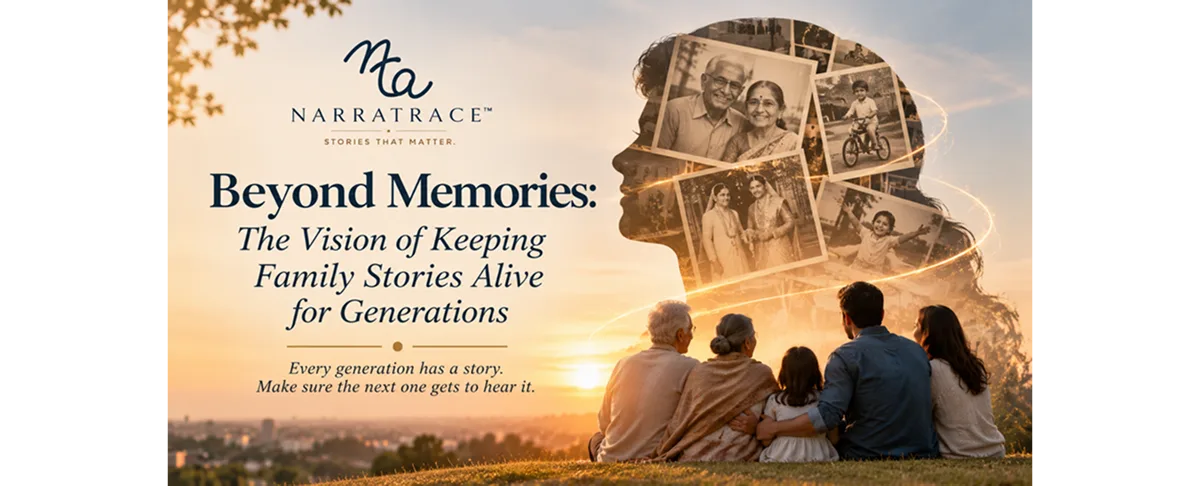
During a family visit to India, founder Raaj Sharma came across a box of old black-and-white photographs. The photographs contained familiar faces, including his father and other relatives.
He recognised the people, but the stories surrounding those photographs were largely unknown to him.
He wanted to understand the occasions, the places, the years and the circumstances behind those images. The photographs had survived, but much of their meaning had not travelled with them.
That experience raised a question that eventually became the foundation of Narratrace: how many family stories remain undocumented simply because nobody thought to ask about them at the right time
Narratrace emerged from the desire to create a way of preserving these conversations before they are lost.
Its vision extends beyond keeping family photographs or recording occasional messages. It is about giving individuals an opportunity to document their lives in their own words, while making those experiences easier for loved ones to discover and understand.
The idea is simple: the people who know our stories should have a way to tell them, and the people who come after us should have an opportunity to hear them.
How Can Guided Life Story Interviews Change the Way We Preserve Memories?
One of the biggest obstacles to documenting personal history is knowing where to begin.
Writing an autobiography requires time, effort and a certain level of confidence in expressing oneself. Many people have remarkable experiences to share but may not be comfortable sitting down to write several pages about their lives.
Others simply do not know which memories are worth documenting.
This is where guided life story interviews can make a meaningful difference.
Instead of expecting someone to create an entire life narrative independently, a guided conversation introduces thoughtful questions that encourage reflection. One answer can naturally lead to another, allowing details to emerge without making the experience feel like a formal questionnaire.
For example, asking someone about their childhood home can lead to conversations about family routines, neighbourhoods, relationships and the people who influenced their early years.
Similarly, asking about a first job may reveal far more than a professional milestone. It might uncover the circumstances behind a career decision, an important mentor or a lesson that remained relevant throughout their life.
An effective storytelling process should encourage people to explore:
- Early life and childhood: The places, people and experiences that shaped their formative years.
- Relationships and family: The connections, traditions and defining moments that influenced their lives.
- Professional experiences: Career decisions, achievements, setbacks and lessons from working life.
- Personal turning points: Experiences that changed their outlook, priorities or direction.
- Values and reflections: The principles they developed and the advice they would like to pass on.
Narratrace uses AI-guided interviews to help make these conversations more natural. Its questions can explore individual responses, while transcription helps turn spoken recollections into written records. Users can also preserve voice and video responses.
The purpose is not to make everyone’s story sound the same. It is to make it easier for every individual to tell their story in their own way.
Why Preserving a Person’s Voice Matters More Than We Realise
There is a particular feeling associated with hearing someone speak in a familiar voice.
It may be the way a parent laughs, the way a grandparent explains something or the distinctive expressions someone uses while telling a story. These details are often so familiar that we rarely consider how meaningful they are.
Written records can preserve information, but voice recordings retain another dimension of personal identity.
A sentence written on paper communicates its words. A voice recording can also convey the pauses, expressions, emotions and personality behind those words.
This is why voice memory preservation deserves a place in modern family storytelling.
Consider the difference between reading a message from a loved one and hearing them explain it themselves. Both have value, but the experience is different.
Narratrace allows users to include voice and video responses within their interviews, helping retain the storyteller’s original expressions alongside the written record.
This can be particularly meaningful when documenting:
- Personal messages intended for children and grandchildren.
- Stories about significant family events.
- Reflections on important life decisions.
- Personal experiences that are difficult to communicate through writing.
- Advice and lessons intended for future family members.
The intention is not to replace the conversations families have today. It is to give those conversations another way to remain accessible tomorrow.
Sometimes, what we want to remember is not just what someone said. It is how they said it.
From Today’s Conversations to Tomorrow’s Milestones: The Idea of Time Capsule Letters
Not every meaningful message needs to be shared immediately.
Some words are written with a particular moment in mind. A parent may want to leave a letter for a child’s graduation. Someone may wish to write to a future grandchild who has not yet been born. A couple might want to preserve a message for a significant anniversary.
These are examples of communication that connects the present with the future.
Digital time capsule letters make this idea more practical by allowing individuals to write messages today and schedule their delivery for a selected future occasion.
Narratrace brings this concept into its platform through Time Capsule Letters.
The process gives users an opportunity to:
- Write a personal letter intended for someone important.
- Preserve the message in their own voice where desired.
- Select a future delivery date.
- Associate the message with a meaningful occasion, such as a birthday, wedding or graduation.
- Allow the message to reach its intended recipient at the scheduled time.
Imagine a child receiving a letter written by a parent years earlier, on the day they graduate. The message may contain advice, encouragement or a memory from their childhood.
The significance of that letter is not simply in its contents. It is also in the fact that someone thought about that moment long before it arrived.
This is one of the more meaningful possibilities of personal storytelling technology: creating connections between people across different stages of life.
Building a Family Heritage That Can Be Explored, Not Just Stored
A meaningful family record should not become another collection of files that nobody knows how to navigate.
The experiences of an individual develop over many years. Childhood, education, relationships, professional life and personal milestones each contribute different perspectives to the larger story.
Organising these experiences into life chapters makes them easier to understand and revisit.
Narratrace’s Decade Archive provides a way to organise interviews and recordings into different periods of a person’s life. This gives personal histories a clearer structure instead of leaving memories scattered across unrelated files.
Photo Memories offer another dimension by bringing photographs together with their associated stories and context. Optional AI-assisted photo exploration can suggest insights and questions based on selected photographs and family context supplied by the user, subject to their permission and review.
The Circles feature also allows users to share selected completed interviews with designated groups, such as grandchildren, cousins or close friends, without making their entire archive public.
Together, these capabilities support a more considered approach to family heritage documentation.
The objective is not to create a perfect historical account. It is to preserve the perspectives and experiences that might otherwise remain known to only one person.
A More Personal Relationship With Technology
Technology is often evaluated through speed, convenience and efficiency. But when it comes to family history, its value should also be measured by the connections it helps people maintain.
Artificial intelligence has introduced new ways to interact with information, ask questions and organise personal records. However, its role in preserving human experiences requires particular care.
A personal story should not become a generic piece of generated content. The individual’s original perspective, language and experiences should remain central to the process.
Narratrace approaches AI as a storytelling facilitator. It helps guide interviews, explore additional details and organise responses, while the storyteller remains the source of the memories being preserved.
There are also important considerations around ownership and privacy.
Personal histories may include sensitive family experiences, private reflections and conversations that were never intended for public distribution. Users should be able to decide what they preserve and who can access it.
Narratrace describes its approach as private by default, with encrypted storage and transmission, permission-based sharing and export options for supported content. It also states that private memories are not used to train AI models.
These principles matter because technology should support personal expression without taking away an individual’s control over their own history.
What Does the Future of Family Storytelling Look Like?
Imagine a future in which family members can explore more than names and dates when learning about previous generations.
They can hear how someone described their first home, understand why a particular decision mattered or discover the values that shaped their family’s journey.
They may find a photograph accompanied by the story of the person who took it. They may revisit a voice recording containing advice that becomes relevant at an unexpected stage of life. They may receive a letter that was written years earlier for a moment that has finally arrived.
This is the broader possibility behind intergenerational storytelling.
It changes the way family history is experienced. Rather than depending entirely on occasional conversations or inherited photographs, families can build a more accessible record of their experiences.
There is also an opportunity for younger generations to participate.
Children and grandchildren can ask questions, learn about the circumstances in which their families lived and discover perspectives that may not have been discussed before.
For older generations, it offers a chance to share experiences that deserve to be heard.
For individuals documenting their own journeys, it provides a space to reflect on how their lives have evolved.
The future of family storytelling should not be about creating elaborate biographies for everyone. It should be about making the simple act of preserving a meaningful experience easier and more natural.
About Narratrace: An Idea Built Around the Stories We Should Not Lose
Narratrace began with a simple realisation: the people closest to us often carry stories we know very little about.
The inspiration came from a box of old photographs, conversations with a father and the understanding that memories can lose their meaning when the context behind them disappears.
What began as a personal question developed into a broader vision for how individuals and families could preserve their experiences.
Today, Narratrace brings together guided AI interviews, voice and video recordings, organised life chapters, photo memories, private sharing circles and scheduled letters.
Each capability serves a common purpose: helping people capture what matters to them and decide how those memories should be revisited and shared.
The platform is built around the belief that everyone has a story worth telling. It does not matter whether someone’s life has been defined by professional achievements, family responsibilities, personal challenges, travel, relationships or ordinary everyday experiences.
A life does not need to be extraordinary to deserve documentation.
Sometimes, the most meaningful details are the ones that would never appear in a formal biography.
Narratrace wants to make room for those details.
Its vision is not simply to help people look back. It is to help them leave something meaningful for the people who will look back after them.
Summary: The Future Should Know More Than Our Names
Every generation inherits something from the one before it. Sometimes it is a family tradition, sometimes a photograph, sometimes a familiar expression or a lesson that has been repeated for years.
But there is so much more that can be passed on.
The circumstances behind important decisions, the experiences that shaped individual lives, the voices that made a house feel like home and the personal wisdom developed over decades all contribute to a family’s identity.
Preserving these experiences requires more than remembering that they happened. It requires creating opportunities to document, organise and share them while the people who lived them can still tell their stories.
Through guided life story interviews, voice and video preservation, photo memories, organised archives and digital time capsule letters, Narratrace is working towards a more personal approach to family storytelling.
The larger vision is straightforward: make it easier for people to preserve their experiences today, so that those experiences can continue to hold meaning for others tomorrow.
Because one day, someone may want to know more than what their family looked like. They may want to know what their family believed, what they experienced, what they dreamed of and what made them who they were.